
India is deeply concerned by the growing consolidation of Pakistan-backed jihadi and radical Islamist groups in Bangladesh, particularly in the strategically vital Chittagong Hill Tracts, which experts warn is transforming the country into a new safe haven for these networks and posing a direct threat to India's security.

We are back to the 1971 moment with both China and the US supporting Pakistan, asserts Colonel Anil A Athale (retd).

Pakistan's government is exploring measures, including potential smart lockdowns and austerity, to reduce petroleum consumption. This comes after recent fuel price hikes driven by rising global oil prices and West Asia tensions, which have also raised concerns about oil supply disruptions. The government is also implementing a fuel relief scheme and faces public pressure over the price increases.

'It beggars belief that Saudi Arabia would deploy military force against India, a top partner and market.'

Former US President Donald Trump expressed strong disapproval of Norway and the Nobel Peace Prize committee for not awarding him the prize. Speaking at a rally on Friday, Trump asserted he deserved the award multiple times for his alleged role in settling conflicts and preventing a war between India and Pakistan, while criticising the actual recipient, Navi Pillay.

Ramlila Maidan, recently designated as one of Delhi's new protest sites, is proving to be a costly and difficult option for demonstrators. With no free dates for the next two and a half months and booking fees exceeding Rs 1 lakh, it contrasts sharply with the previously free Jantar Mantar. The ground, rich in political history, also poses logistical challenges due to its busy commercial location and impact on traffic.

Pakistani Prime Minister Shehbaz Sharif has briefed Saudi Crown Prince Mohammad bin Salman on Pakistan's diplomatic efforts to de-escalate the situation in West Asia. This follows Pakistan's offer to host talks between the US and Iran to resolve the ongoing conflict.

US Secretary of State Marco Rubio's visit to India this week underscores the complex dynamics of global energy policy, as Washington re-evaluates sanctions on Russian oil buyers amidst India's continued reliance on Russian crude.

Devdutt Padikkal and Mohammed Siraj have joined South Zone for the Duleep Trophy final, while Tilak Varma, Vaibhav Sooryavanshi and Ishan Kishan could feature before India's Afghanistan series.

Mirza Fakhrul Islam Alamgir, secretary general of the ruling Bangladesh Nationalist Party (BNP) and a close ally of former premier Khaleda Zia, has been elected as Bangladesh's new President in the first contested poll for the post in 35 years.

From the adorably vain Poo to the free-spirited Geet, Kareena Kapoor Khan has delivered some memorable performances.

New Delhi must look for formal, institutional statements issued directly from Washington rather than rely on casual pronouncements meant for local audiences, notes Ambassador Rajasekhar.

Veteran politician Mirza Fakhrul Islam Alamgir has been sworn in as Bangladesh's 23rd President, following a contested parliamentary election that saw him defeat Colonel (retd) Oli Ahmed. Alamgir, a longtime secretary general of the ruling Bangladesh Nationalist Party (BNP), will serve a five-year term.
Pakistan, Turkiye, and Saudi Arabia have signed a trilateral defence pact, agreeing to treat an attack on one as an attack on all. Analysts suggest this alliance could significantly diminish the United States' strategic influence in West Asia and elevate Pakistan's geopolitical standing, potentially acting as a deterrent in regional conflicts.
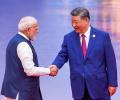
Ahead of Xi Jinping's visit, National Security Advisor Ajit Doval and Chinese Foreign Minister Wang Yi held extensive talks in Beijing on August 25 on the boundary issue and reached an eight-point consensus.

Gwadar is viewed as a critical pearl in China's maritime strategy as it would give a permanent logistical footprint near an important choke point - the Strait of Hormuz and the oil rich Persian Gulf, explains Commodore Venugopal Menon (retd).

On the 25th anniversary of that world-changing morning in New York, it is also for the rest of to reflect. Not only on those who were killed but also on why the event happened and what led to it and what came after it, asserts Aakar Patel.
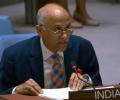
India has strongly criticised Pakistan at the UN Security Council, highlighting civilian deaths and injuries in Afghanistan caused by cross-border violence by Pakistani military forces, accusing Pakistan of 'heinous acts' and 'systematic genocide'.

Veteran Congress leader Karan Singh has called for the establishment of a Himalayan authority involving all Himalayan nations, including India, Pakistan, and Nepal, to protect the fragile mountain range from destruction. He also criticised the four-laning of highways in Uttarakhand's Char Dham region, deeming it "reprehensible" due to its environmental impact. His appeal comes as Nepal grapples with devastating flash floods, highlighting the region's vulnerability.

Nagarmal Bajoria, a 97-year-old Bihar businessman known as "dharti pakad" for contesting nearly 300 elections, has passed away. A Partition refugee, Bajoria challenged prominent leaders including Indira Gandhi and Atal Bihari Vajpayee, aiming to raise public awareness about the electoral process rather than seeking power. His unique campaign style and unwavering spirit left a lasting impression.

US Secretary of State Marco Rubio met with Pakistan's Foreign Minister Ishaq Dar amid American demand that countries mediating the peace talks with Iran join the Abraham Accords and establish diplomatic and economic ties with Israel.

Prime Minister Narendra Modi, addressing the SCO summit in Bishkek, called for a united front against terrorism and its financing, rejecting double standards. He emphasised resolving conflicts through dialogue and diplomacy, not battlefields. Modi also highlighted that connectivity projects must respect national sovereignty and territorial integrity, a veiled reference to China's Belt and Road Initiative. India's vision for SCO rests on security, connectivity, and opportunity.

India and China are in what experts call 'a cooperation-versus-competition situation'.

'The Chinese military cannot advance much in Ladakh, even if they want to.' 'Similarly, in Arunachal Pradesh, they can rename a village or two, intrude here or there, but cannot do much more realistically.'

In a lengthy post on Truth Social, Trump said negotiations with Iran were 'proceeding nicely' and argued that several Muslim and Arab nations should formally recognise Israel and join the Abraham Accords once a deal is reached.

Sonia Gandhi criticised PM Modi's Israel visit, calling it a "bewildering strategic decision" amid the regional conflict.

Nepal's devastating flash floods have claimed 1,127 lives, with thousands still missing a week after the disaster. Rescuers are intensifying efforts to find survivors and recover bodies across affected regions, while police work to identify victims and relocate families from high-risk areas.

The population is gripped by anxiety against arbitrariness and the cruelty of a state that sells its actions as minimum government, asserts Aakar Patel.

China sailed through the crisis in the Strait of Hormuz relatively unscathed even as the impact of its steps shielded other consuming nations from having to pay high crude oil prices.

India's position appears to be anchored around three red lines: Hasina's safety and the guarantee of a fair trial; assurances that Bangladeshi territory will not be used for activities hostile to India; and the restoration of an inclusive democratic process in Bangladesh.

Despite calls for his ouster after the Test series defeat against Bangladesh, Pakistan skipper Shan Masood wants to continue leading the national side in the near future, sources in the PCB indicated.

Indian javelin throwers Neeraj Chopra, Rohit Yadav, and Yash Vir Singh have successfully qualified for the men's javelin final at the Commonwealth Games 2026 in Glasgow, overcoming challenging windy conditions.

The high court granted the petitioner one opportunity to establish her claim to Indian citizenship.
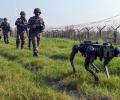
Union Home Minister Amit Shah announced the launch of a tech-enabled 'smart border' project to secure India's borders with Pakistan and Bangladesh. The project aims to stop infiltration and combat demographic changes.

If Trump wants peace with Iran, Pakistan will offer to help. If Trump seeks Pakistan's aid to spy on Iran, then too Munir will not hesitate to chip in. At the same time, the ISI will not hesitate to tip off Iran now and then, points out M R Narayan Swamy.

The United States' historical strategic alignment with Pakistan, dating back to the Cold War, has consistently aimed to create a political and military parity with India, despite India's significantly larger size and resources. This long-standing relationship continues to influence regional dynamics, particularly in West Asia and the Indo-Pacific.

'The flip side of this is that he won't hesitate to call out India if he thinks its policies are hurting US economic interests or border US foreign policy goals.'

Iran was the chance to arrange a concert of nations, to actually be a Vishwaguru. Instead, we are watching from the sidelines as Pakistan, the same country that is apparently still at war with Afghanistan, hosts talks between US-Israel and Iran. The irony is hard to miss, points out Amberish K Diwanji.
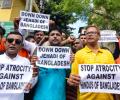
'Prime Minister Sheikh Hasina is sincere about maintaining religious harmony in the country.' 'But for mysterious reasons, it does not reach the grassroots activists of her party.'

Pakistan is set to host face-to-face talks between the United States and Iran, aiming to solidify a fragile ceasefire and prevent further conflict in West Asia. The discussions will focus on a long-term peace arrangement, including sanctions relief, regional security, and Iran's nuclear program.
